Retrieval-augmented generation, built from the ground up.
Project
R&D project
Year
2025
Our focus
RAGEmbeddingsPython
How do you build a RAG pipeline without a vector database?
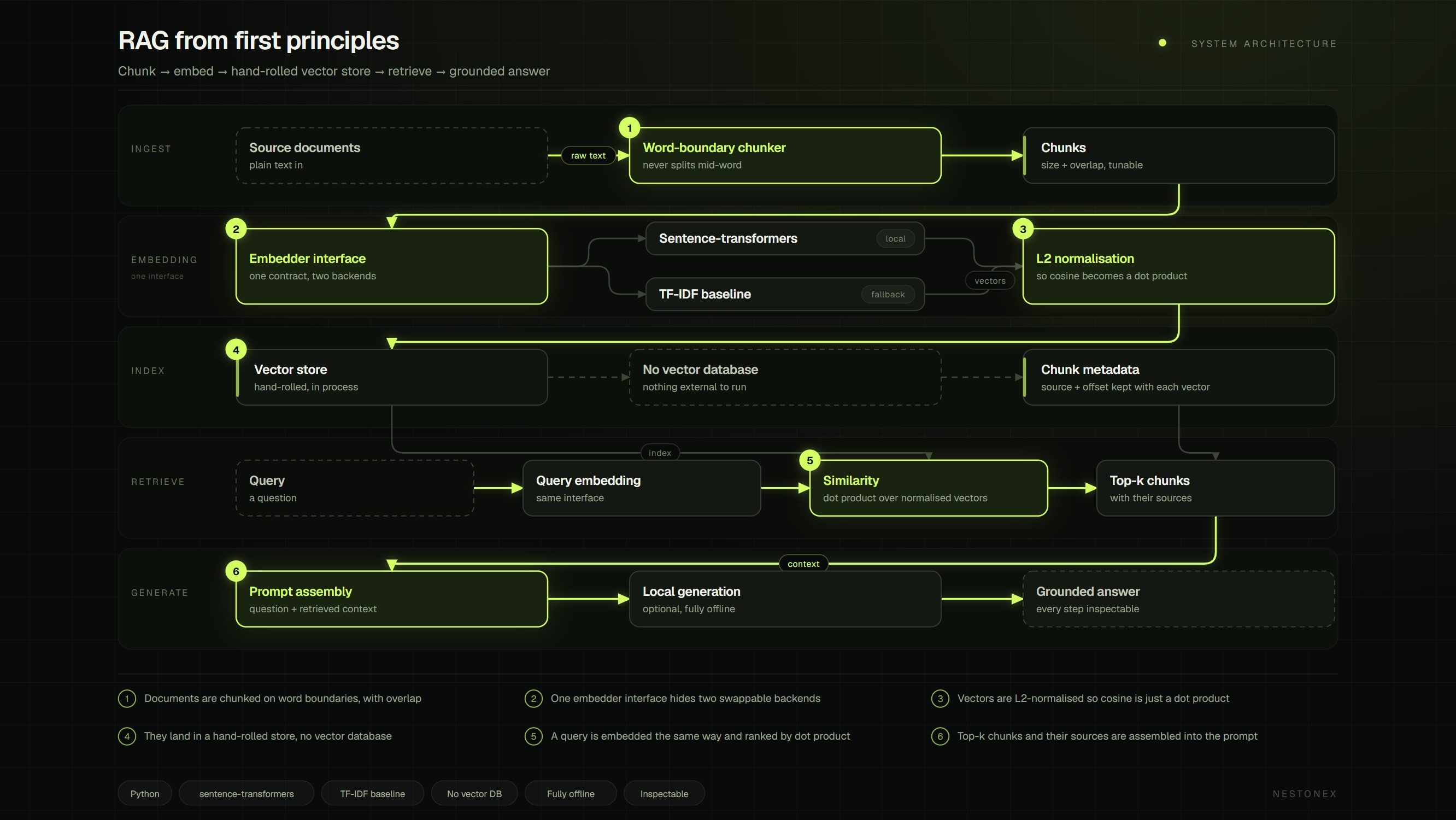
Normalise your vectors and the database stops being necessary. Once every embedding has unit length, cosine similarity is just a dot product, and a hand-rolled in-process store handles retrieval with no external service. This build chunks on word boundaries, embeds through one swappable interface, and runs entirely offline.
System architecture · RAG pipeline
01 /Why build RAG from scratch instead of using a managed service?
To understand it. A managed pipeline hides the decisions that determine whether retrieval works, and those decisions are where most RAG systems actually fail: chunk size, chunk boundaries, what gets embedded, how similarity is computed.
This was an R&D project rather than client work, built to make every one of those steps visible and adjustable. Running it fully offline was a constraint chosen on purpose, since anything that phones out is a step you cannot inspect.
02 /Why does cosine similarity become a dot product?
Cosine similarity divides the dot product of two vectors by the product of their magnitudes. If both vectors are already normalised to unit length, those magnitudes are 1, and the division does nothing.
So normalising at write time removes work from every subsequent query. It is a small piece of arithmetic that turns retrieval into a single matrix operation, which is most of the reason a dedicated vector database is optional at this scale.
03 /Why chunk on word boundaries?
Because splitting a document every N characters cuts words in half, and half a word embeds as noise. It is the kind of detail a managed pipeline handles silently and a hand-rolled one has to get right.
Chunk size and overlap are both tunable. Overlap matters because a fact that straddles a boundary is otherwise retrievable from neither chunk.
04 /What does one embedder interface with two backends buy you?
The ability to change your mind. Local sentence-transformers give proper semantic embeddings; a TF-IDF baseline gives keyword matching with no model at all. Both sit behind the same interface.
Having the baseline is not a fallback so much as a control. If semantic embeddings are not beating TF-IDF on your corpus, that is worth knowing before you build anything else on top of them.
05 /What is kept alongside each vector?
Source and offset. A retrieved chunk that cannot be traced back to where it came from produces an answer nobody can verify, which defeats the purpose of retrieval augmentation.
Top-k chunks are assembled into the prompt with their sources attached, and generation is optional and local, so the whole pipeline can run with no network access at all.
06 /What we delivered
Swappable embedders behind one interface
Word-boundary chunking
Hand-rolled normalized vector store
Optional local generation, fully offline
07 /The outcome
A reference RAG pipeline that runs entirely offline and stays fully inspectable at every step.
08 /Build at a glance
Chunking
Word boundaries, tunable size and overlap
Embedders
sentence-transformers, TF-IDF baseline, one interface
Normalisation
L2, so cosine similarity becomes a dot product
Store
Hand-rolled, in-process, no external vector database
Metadata
Source and offset kept with each vector
Retrieval
Top-k by dot product over normalised vectors
Generation
Optional and local
Network
None required, fully offline
COMMON QUESTIONS
Questions people actually ask
Do you need a vector database for RAG?
Not at small to moderate scale. If embeddings are L2-normalised, similarity is a dot product and retrieval is one matrix operation over an in-process array. A dedicated vector database earns its place when the corpus outgrows memory or needs concurrent writers, not by default.
Why normalise embeddings before storing them?
Because cosine similarity divides the dot product by both magnitudes, and normalising makes those magnitudes 1. Doing it once at write time removes that division from every query afterwards, turning retrieval into a single dot product.
What chunk size should a RAG pipeline use?
It depends on the corpus, which is the argument for making it tunable rather than fixed. What matters more universally is splitting on word boundaries rather than character counts, and using overlap so a fact straddling a boundary stays retrievable.
Is TF-IDF still useful alongside embeddings?
As a control, yes. If semantic embeddings are not measurably beating a TF-IDF baseline on your corpus, that is important to discover early. Keeping both behind one interface makes the comparison cheap to run.