A B2B marketplace for construction and industrial materials.
Project
Client marketplace
Year
2024–25
Our focus
MarketplacePaymentsKYC
How do you build a B2B marketplace where vendors are paid automatically and correctly?
Give every supplier their own payment account and split at the point of sale. This marketplace creates a business account per supplier, splits each order's proceeds automatically between platform commission and vendor wallet, and gates it behind automated KYC that cut vendor onboarding time by around 75%.
materials.suppliersLIVE
Materials Suppliers · B2B marketplace
01 /Why give each supplier their own payment account?
Because the alternative is holding everyone's money in one pot and reconciling it later, which is both an accounting burden and a regulatory question nobody wants to answer.
Creating a business account per supplier means the split happens at the payment layer, where it belongs. The platform takes commission and the vendor receives the rest, and neither party depends on a manual transfer running correctly at month end.
02 /What does automated KYC actually change?
The speed of the slowest part. Vendor onboarding in a B2B marketplace is mostly document checking, and doing it by hand is the bottleneck between a signup and a live catalogue.
Automating the document verification cut that onboarding time by roughly 75%. That is not a technical win so much as a commercial one: suppliers who can list on the day they sign up are suppliers who actually list.
03 /How is access scoped across so many roles?
Role-based permissions across the API. A buyer, a supplier and an administrator see different slices of the same orders, products and payouts, and the scoping is enforced per role at the API rather than assumed by the interface.
The domain is large, roughly 30 controllers and 81 data models behind 400-plus endpoints, so keeping permission logic in one consistent layer matters more than it would on a small application.
04 /How do quotes fit into a catalogue marketplace?
B2B buying rarely works at list price. Construction and industrial materials are bought in quantities where the price is negotiated, so a quote flow sits alongside the catalogue rather than replacing it.
That means the same product can be browsed at a listed price and transacted at an agreed one, with commission still computed correctly on whatever was actually paid.
05 /What does the deployment look like?
It ships on AWS. The catalogue, orders, wallets and KYC pipeline all run as one coherent system rather than a set of loosely connected services, which suited the size of the team and the need to change the domain quickly.
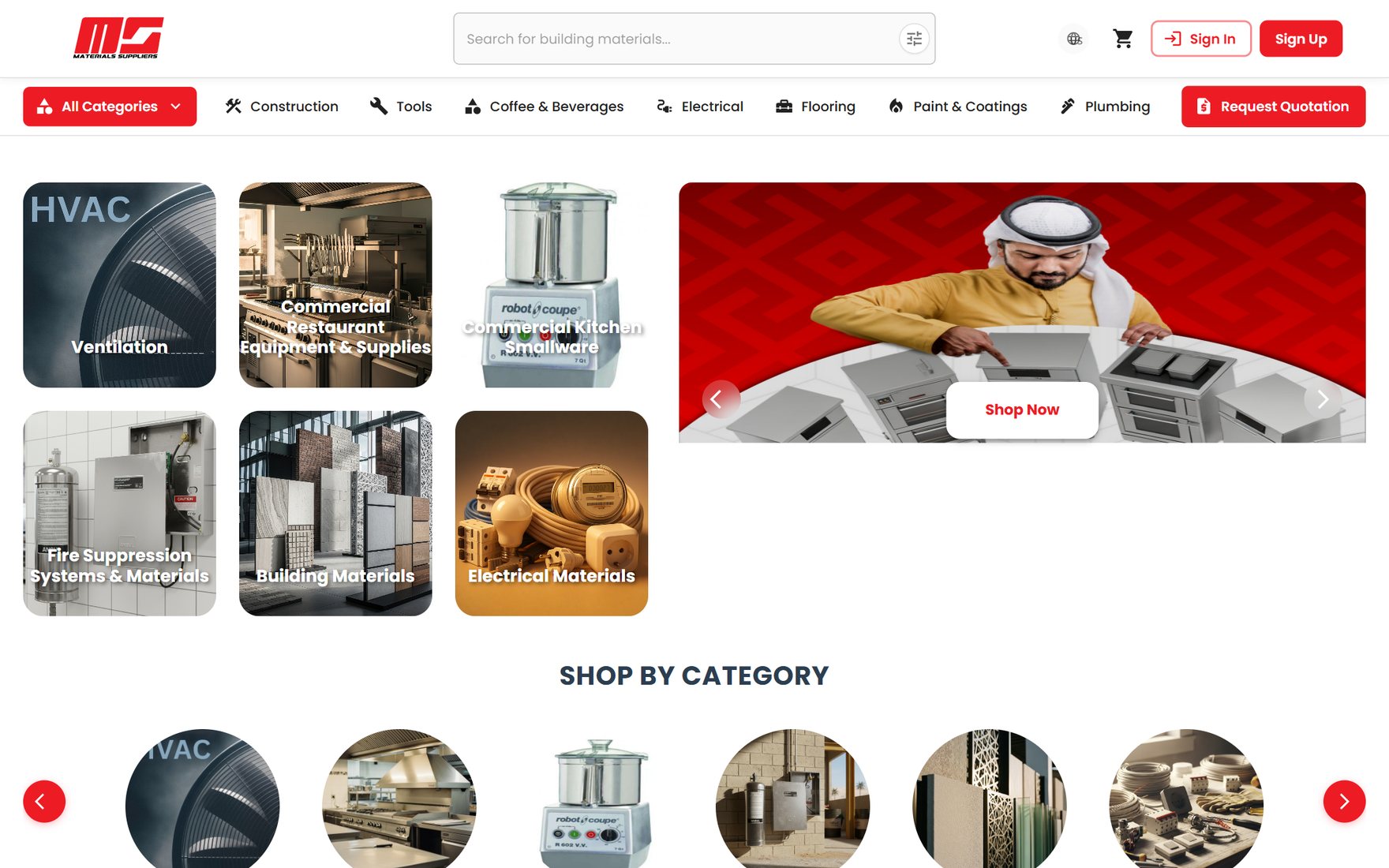
The storefront covers the categories a construction buyer actually needs, from building materials and electrical to commercial kitchen equipment.
06 /What we delivered
400+ endpoint marketplace API
Split vendor payouts and wallets
Automated KYC and document verification
Role-based permissions across roles
07 /The outcome
A multi-vendor marketplace across 30 controllers and 81 data models, shipped to AWS, with KYC that cut vendor onboarding time by 75%.
08 /Build at a glance
Marketplace type
B2B, multi-vendor, construction and industrial materials
API
400+ endpoints across 30 controllers
Domain
81 data models
Access control
Role-scoped permissions enforced at the API
Payments
Supplier business accounts with automatic split payouts
Wallets
Per-vendor balance and payout history
Onboarding
Automated KYC and document verification
Onboarding impact
Around 75% faster vendor onboarding
Hosting
AWS
COMMON QUESTIONS
Questions people actually ask
How do marketplace split payments work?
Each vendor gets their own payment account, and the proceeds of an order are divided at the point of payment between platform commission and the vendor's balance. Splitting at the payment layer avoids holding everyone's money in one pot and reconciling it manually later.
Why does a B2B marketplace need quotes as well as listed prices?
Because B2B buying at volume is negotiated. Construction and industrial materials are rarely bought at list price, so a quote flow has to sit alongside the catalogue, with commission still computed correctly against whatever price was actually agreed.
How much does automated KYC speed up vendor onboarding?
On this marketplace, by around 75%. Vendor onboarding is mostly document checking, and doing it manually is the bottleneck between signing up and having a live catalogue. Automating verification turns a multi-day wait into a same-day listing.
How should permissions work in a multi-vendor marketplace?
Enforced at the API per role, not assumed by the interface. Buyers, suppliers and administrators all read the same orders and products from different angles, so a single consistent permission layer is what stops one role seeing another's data.