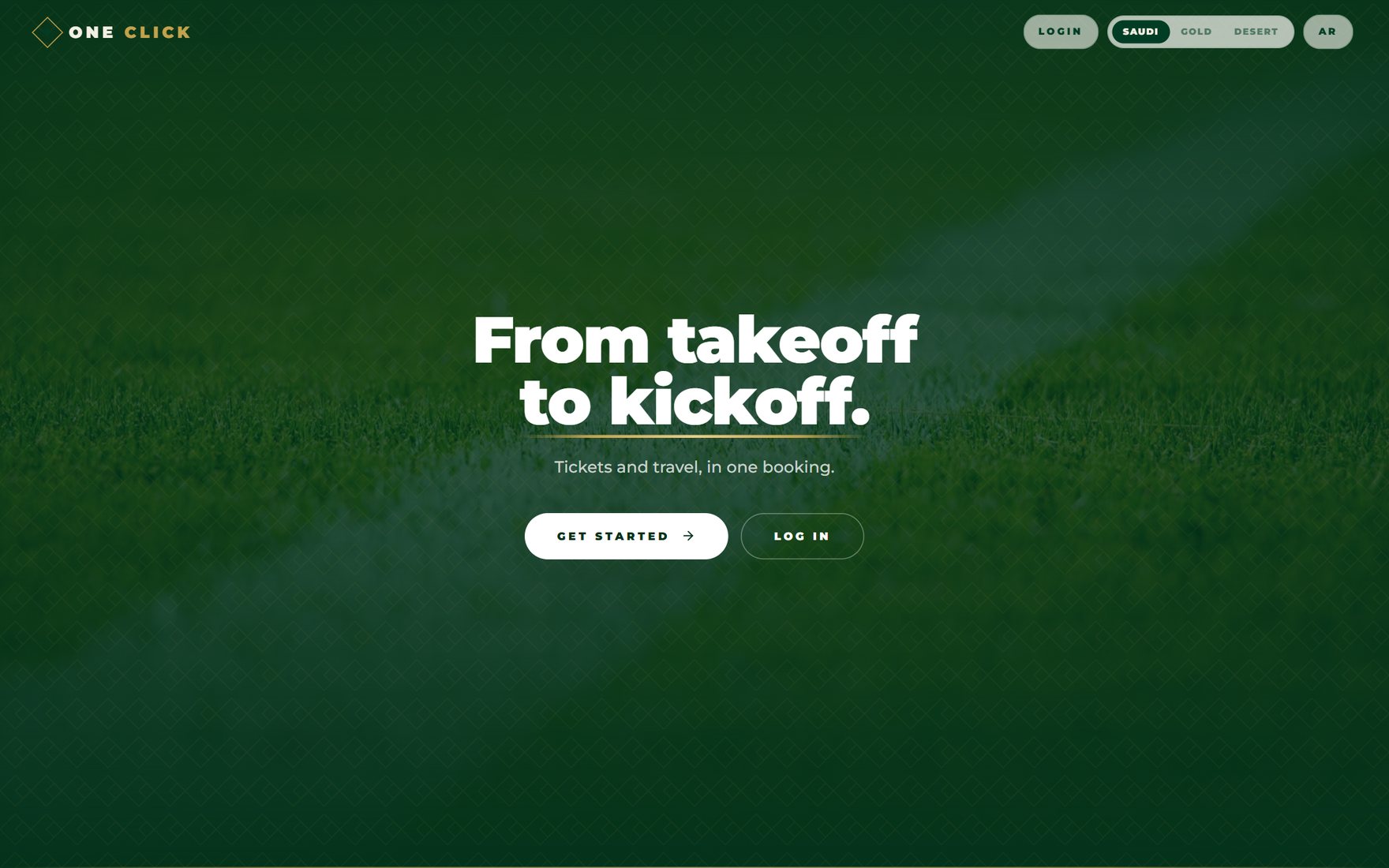
Match-day travel for Saudi Arabia, in a single booking.
Project
Product design & build
Year
2025
Our focus
Frontendi18n / RTLProduct design
How do you design a booking product that works equally well in Arabic and English?
Build right-to-left into the design system rather than bolting it on. One Click was designed bilingual from the start, with RTL-aware layouts, swappable visual themes and a booking flow that bundles match tickets, flights, transfers and hotels into a single checkout priced in SAR.
one-click.bookingLIVE
One Click · match-day travel concierge
01 /Why is retrofitting Arabic support so expensive?
Because direction is not a translation problem, it is a layout problem. In right-to-left the whole reading order flips: navigation, icons that imply direction, progress indicators, form alignment, even where a back button belongs.
A product designed left-to-right and translated afterwards ends up with mirrored text inside unmirrored layouts, which reads as broken to a native speaker. Designing both directions together costs a fraction of fixing it later.
02 /What actually has to flip, and what must not?
Layout, alignment and directional icons flip. Numbers, and a progress bar showing a booking moving forward, generally should not, and that judgement has to be made component by component.
Getting this wrong is subtle rather than obvious. It does not throw an error, it just makes the product feel foreign to the audience it was built for.
03 /Why bundle tickets, flights, transfers and hotels?
Because that is the actual trip. A match-day journey booked across four sites is four chances to end up with a hotel that does not match the fixture or a transfer that lands after kick-off.
Bundling them into one flow is the entire product proposition. The engineering consequence is that the booking flow has to hold a coherent trip together through auth, selection and payment rather than treating each component as an independent purchase.
04 /What does OTP-verified auth add to a travel booking?
A verified phone number attached to a trip. For travel, contact details are not an account detail, they are how someone is reached when a flight moves.
Verifying at signup rather than trusting a typed number means the one channel that matters during a disruption is known to work.
05 /What do swappable visual themes give you?
Room to move. The same booking flow can be re-skinned for a different event or partner without rebuilding the interface, which matters for a product tied to fixtures rather than to a single evergreen brand.
The build was designed and engineered front to back as a deploy-ready product rather than a prototype, priced in SAR for the market it targets.
06 /What we delivered
Bilingual, RTL-aware interface
Bundled tickets, flights, transfers and hotels
OTP auth, payment forms and referrals
Swappable visual themes
07 /The outcome
A high-fidelity, deploy-ready travel concierge priced in SAR, designed and built front to back.
08 /Build at a glance
Languages
English and Arabic, full parity
Direction
RTL-aware layouts designed in, not retrofitted
Bundle
Match tickets, flights, transfers, hotels
Auth
OTP-verified phone signup
Payment
In-flow payment, priced in SAR
Theming
Swappable visual themes
Extras
Referral flow
Status
Designed and built front to back, deploy-ready
COMMON QUESTIONS
Questions people actually ask
What does RTL-aware mean in interface design?
That the layout itself flips for right-to-left languages, not just the text. Navigation order, alignment, directional icons and back buttons all reverse, while numbers and forward-moving progress indicators generally do not. It is a per-component judgement, which is why it is hard to add later.
Why is adding Arabic support after launch so expensive?
Because direction is a layout concern rather than a translation concern. Translated text inside a layout built for left-to-right reads as broken to a native speaker, and fixing it means revisiting every component. Designing both directions from the start costs a fraction of that.
Should a travel product bundle tickets, flights and hotels into one booking?
If the trip is built around a fixed event, yes. Booking a match-day journey across four sites invites mismatches between the fixture and the hotel or a transfer that arrives after kick-off. Bundling makes the product coherent, at the cost of the flow having to hold a whole trip together.
Why use OTP verification for travel bookings?
Because the phone number is how a traveller gets reached when a flight moves. Verifying it at signup rather than trusting what was typed means the one contact channel that matters during a disruption is known to work.