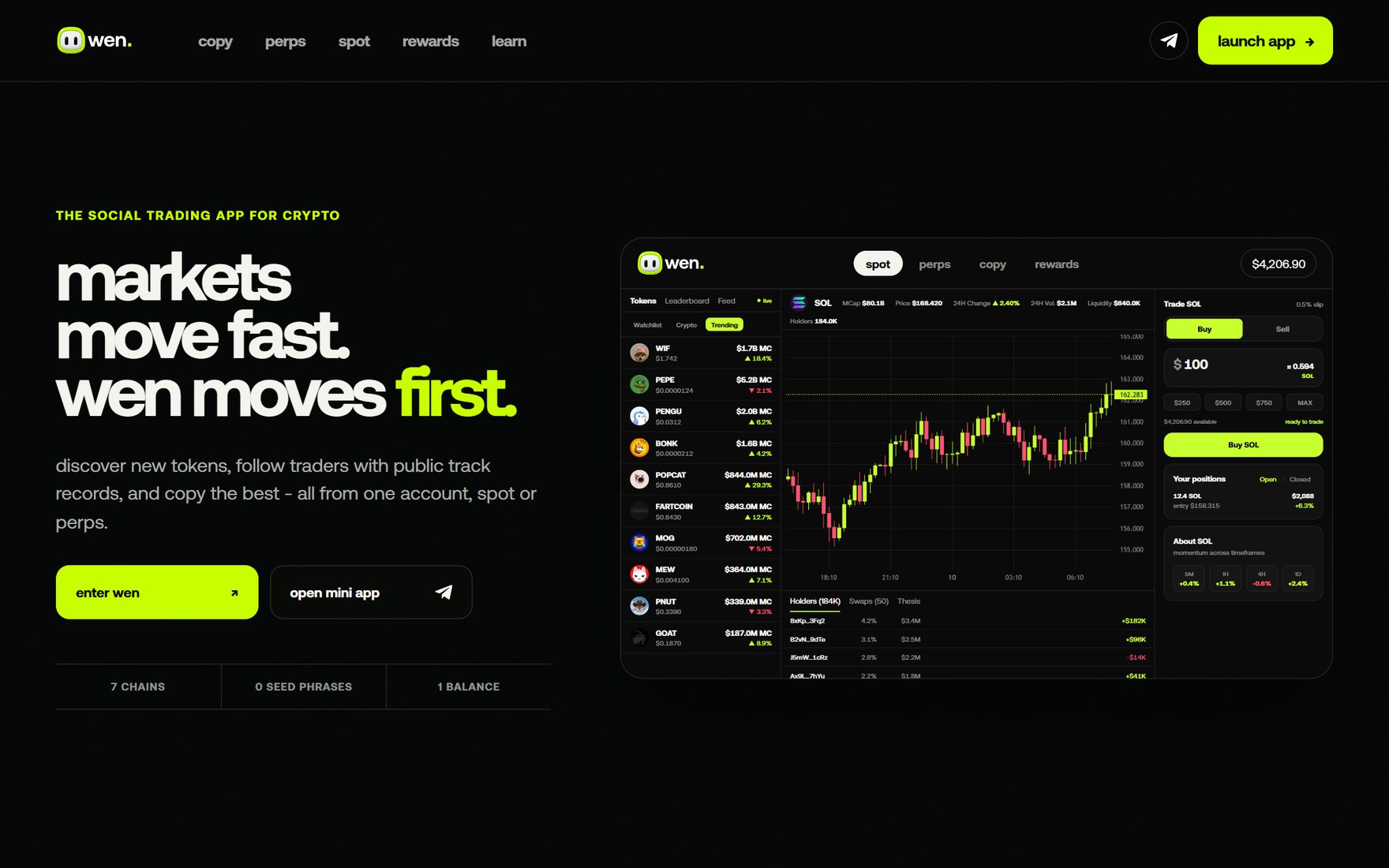
One account for perps, spot and copy-trading — and an AI that can trade for you.
Project
Product engineering
Year
2026
Our focus
AI agentsTrading systemsWeb3
How do you let an AI place trades in a wallet app without ever holding the user's keys?
Wen runs on embedded wallets, so the backend never holds a private key at any point. The in-app AI agent cannot move funds directly either; it calls typed, validated tools that go through the same checks as a tap in the interface. Key export exists, gated behind two-factor.
wen.liveLIVE
Wen · live trading super-app
01 /What does non-custodial actually mean here?
It means the service has nothing to steal and nothing to lose. Keys live in embedded wallets tied to the user, not in a vault the backend can reach, so a breach of the API does not put balances at risk.
Users can export their private key and leave, which is the real test of the claim. That export sits behind a two-factor gate, because the one moment the key is exposed is the one moment worth protecting hardest.
02 /How does the AI agent place a trade safely?
The agent does not write transactions. It selects from a set of typed tools with validated arguments, and every one of those tools runs the same checks as the equivalent action in the interface. There is no privileged path for the model.
That design means a bad generation produces a rejected tool call rather than a bad trade, and it keeps one set of rules to reason about instead of two.
03 /How does copy-trading size a follower's position?
A copied trade is not a clone. Each follower has their own sizing, so a leader's position is translated into something proportionate to the follower's balance and risk settings rather than mirrored outright.
Perpetuals add leverage to that calculation, so execution has to understand margin rather than treating every fill as spot.
04 /How does one backend run as API, worker and indexer?
The same service boots into a role. One deployment can come up as the API, as a background worker, or as a chain indexer, which keeps a single codebase and a single set of models instead of three drifting services.
The event pipeline behind it is idempotent, so a replayed or duplicated chain event settles to the same state rather than double-crediting a reward or double-filling an order. On-chain data arrives more than once; assuming otherwise is how ledgers go wrong.
05 /Why ship it as a Telegram mini-app?
Because the audience is already there. Crypto trading communities live in Telegram, and a mini-app removes the install step entirely while keeping a full web experience for anyone who wants one.
The same backend serves both surfaces, roughly 259 routes of it, so the mini-app is a client rather than a separate product.
06 /What we delivered
AI trading agent over typed, validated tools
Copy-trading engine with per-follower sizing
Leverage-aware perpetuals execution
2FA-gated private-key export
07 /The outcome
A live social trading app that unifies discovery, execution and rewards, delivered as a Telegram mini-app with a web experience on a 259-route backend.
08 /Build at a glance
Custody
Non-custodial, embedded wallets, backend holds no keys
Can an AI agent trade on your behalf without custody of your funds?
Yes, if the agent is restricted to calling validated tools rather than signing transactions. In Wen the keys sit in embedded wallets the backend cannot reach, and the agent's tool calls run the same validation as a manual action, so it can propose a trade but cannot invent one.
What is an embedded wallet?
A wallet created and held for the user inside the application rather than in a separate extension, without the service taking custody of the key. It removes the seed-phrase step for new users while keeping the wallet genuinely theirs, including the ability to export the key and leave.
How is copy-trading different from mirror trading?
Mirror trading reproduces a position as-is. Copy-trading sizes it to the follower, so a leader trading a large balance does not push a disproportionate position onto a smaller account. Wen applies per-follower sizing and accounts for leverage on perpetuals.
Why do blockchain event pipelines need to be idempotent?
Because chain events arrive more than once. Reorgs, retries and replays all deliver the same event twice, and a pipeline that assumes exactly-once delivery will double-credit rewards or double-process fills. Making the handler idempotent means a repeat settles to the same state.