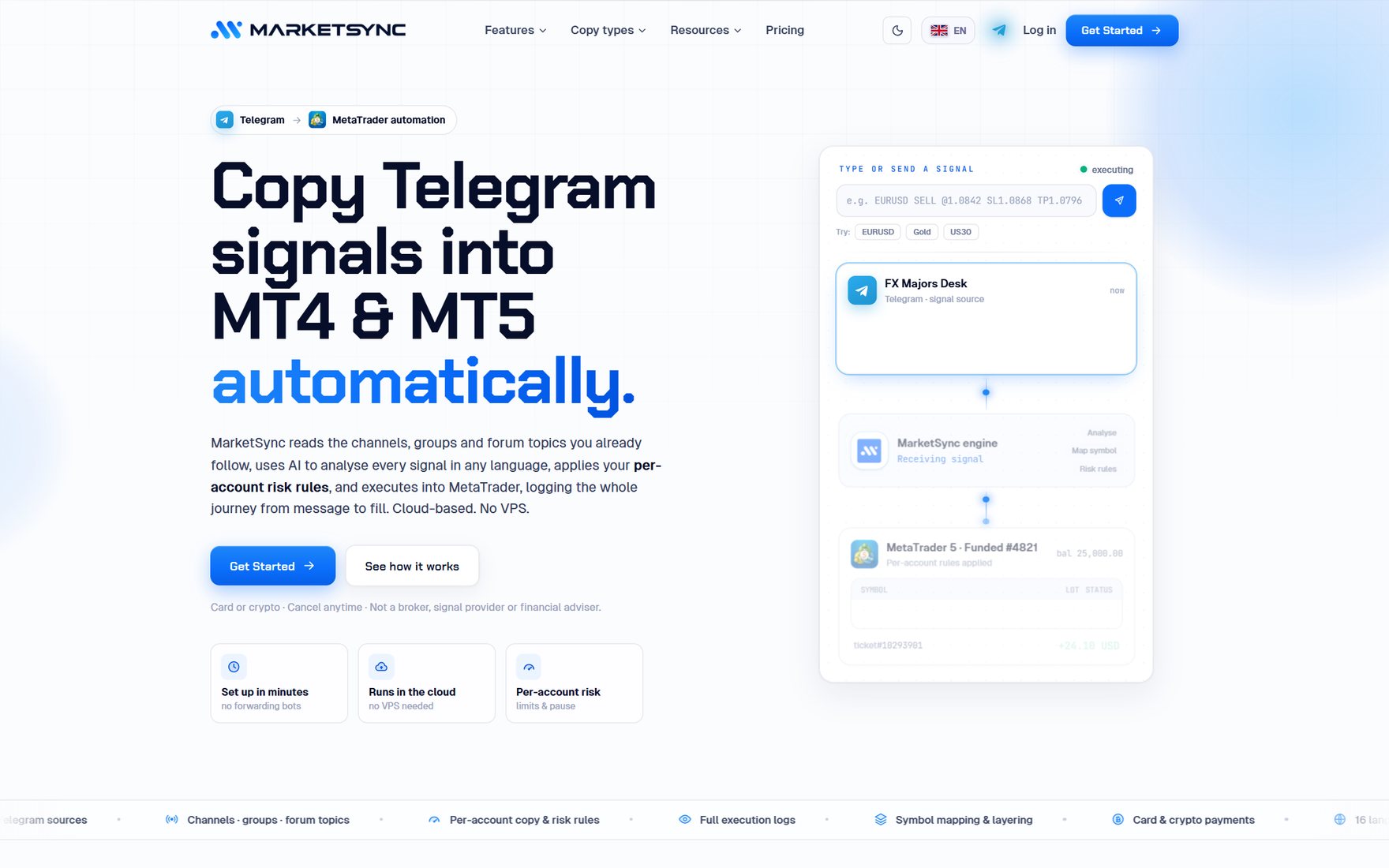
Telegram trading signals, understood and executed on MetaTrader in real time.
Project
Product engineering
Year
2025–26
Our focus
LLM pipelinesTrading automationReal-time systems
How do you turn a Telegram trading signal into a live MetaTrader order?
MarketSync reads the Telegram channels a trader already follows, parses each signal with a fast-path parser backed by a language-model fallback, maps it to the right broker symbol, applies that account's own risk rules, and places the order in the cloud. No VPS and no forwarding bot.
app.marketsync.aiLIVE
MarketSync · live copy-trading platform
01 /How does MarketSync read a Telegram signal?
Most signals arriving from a channel are already in a shape the system recognises: a symbol, a direction, an entry, a stop and one or more take-profit levels. Those go down a fast path, a deterministic parser that resolves them without calling a model at all. It is cheaper, it is faster, and it cannot hallucinate.
The system watches channels, groups and forum topics a trader is already subscribed to, so nothing has to be forwarded into a bot first. When a provider edits a message after posting it, the edit is reprocessed rather than ignored, because a corrected entry price is often the difference between a good fill and a bad one.
02 /What happens when a signal does not match a known format?
The awkward ones fall through to a language model, which is asked for strict JSON against a fixed schema rather than free text. Output that fails to parse is retried, and a concurrency cap stops a burst of thirty signals in one minute from turning into a cost or latency spike.
Anything that still cannot be resolved is logged as unparsed rather than guessed at. A missing stop loss is not something to improvise.
Sixteen locales are supported, so a signal posted in Turkish, Urdu, Arabic or Portuguese is handled the same way as one posted in English.
03 /How are a trader's own risk rules applied?
A signal is treated as a proposal, not an instruction. Each account carries its own configuration profile, and that profile decides what actually gets placed: lot sizing, which take-profit levels to act on, whether to split a multi-entry signal across several orders, how trailing stops behave, and how much spread compensation to allow.
Two accounts can follow the same provider and end up with completely different positions, which is the point. The trader's rules outrank the signal every time.
04 /Which platforms does it execute on?
MetaTrader is the main target, alongside DXtrader and TradeLocker, each behind its own adapter so supporting a new platform is an adapter rather than a rewrite.
Broker rejections are treated as part of the normal flow rather than an error to swallow. A no-quotes response, for example, triggers a recovery path instead of failing silently, because a trader needs to know whether a position actually exists.
05 /Why run execution in the cloud instead of on a VPS?
The usual way to automate MetaTrader is to rent a VPS, install a terminal on it and hope it stays up. That makes uptime the trader's problem and puts a Windows box between them and their money.
MarketSync runs execution as a service, so there is nothing to install and nothing to keep alive. That was a product decision as much as an architectural one: it removes the most common reason people abandon signal automation.
06 /What else is in the platform?
The trading path is roughly half of it. The backend also carries multi-gateway subscriptions and billing, a referral system, a signal marketplace, a paper-trading simulator for testing a provider before risking real money, white-label support, and an AI support assistant with its own caching layer.
Around 450 API routes sit behind a NestJS backend, with a Next.js front end and real-time updates in all sixteen supported languages.
07 /What we delivered
LLM signal parser with model fallback
Execution engine with multi-entry and trailing stops
Multi-provider billing and subscriptions
Real-time updates across 16 languages
08 /The outcome
A cloud-based copy-trading platform running on a backend of around 450 API routes, live at marketsync.ai and serving traders worldwide.
09 /Build at a glance
Signal sources
Telegram channels, groups and forum topics
Parsing
Deterministic fast path, language-model fallback with strict JSON
Languages
16 locales
Execution platforms
MetaTrader, DXtrader, TradeLocker
Order handling
Multi-entry, trailing stops, per-account lot sizing, spread compensation
Risk model
Per-account configuration profiles
Backend
NestJS, around 450 API routes
Front end
Next.js with real-time updates
Also includes
Subscriptions, referrals, signal marketplace, paper-trading simulator, white-label
Do you need a VPS to copy Telegram signals into MetaTrader?
Not with MarketSync. Execution runs as a cloud service, so there is no terminal to install and no virtual machine to keep online. The usual VPS setup makes uptime the trader's own responsibility, which is the most common reason signal automation gets abandoned.
Can a signal copier read trading signals that are not in English?
MarketSync supports sixteen locales, including Turkish, Urdu, Arabic, Hindi, Portuguese and Polish. Signals are parsed on structure rather than language, and a language-model fallback handles phrasing the deterministic parser does not recognise.
What happens if a signal provider edits the message after posting it?
The edit is reprocessed rather than ignored. Providers often correct an entry price or a stop level seconds after posting, and treating the first version as final would put the trade on the wrong side of the correction.
Can two accounts follow the same signal with different risk settings?
Yes. Risk lives on the account, not on the signal. Each account has its own configuration profile controlling lot sizing, take-profit handling, multi-entry splitting, trailing stops and spread compensation, so one signal can produce different positions per account.