Proof of which crypto callers actually make money — and a place to backtest it.
Project
Full-stack build
Year
2025
Our focus
Data engineeringFastAPIDashboards
How do you prove whether a crypto caller's token calls actually made money?
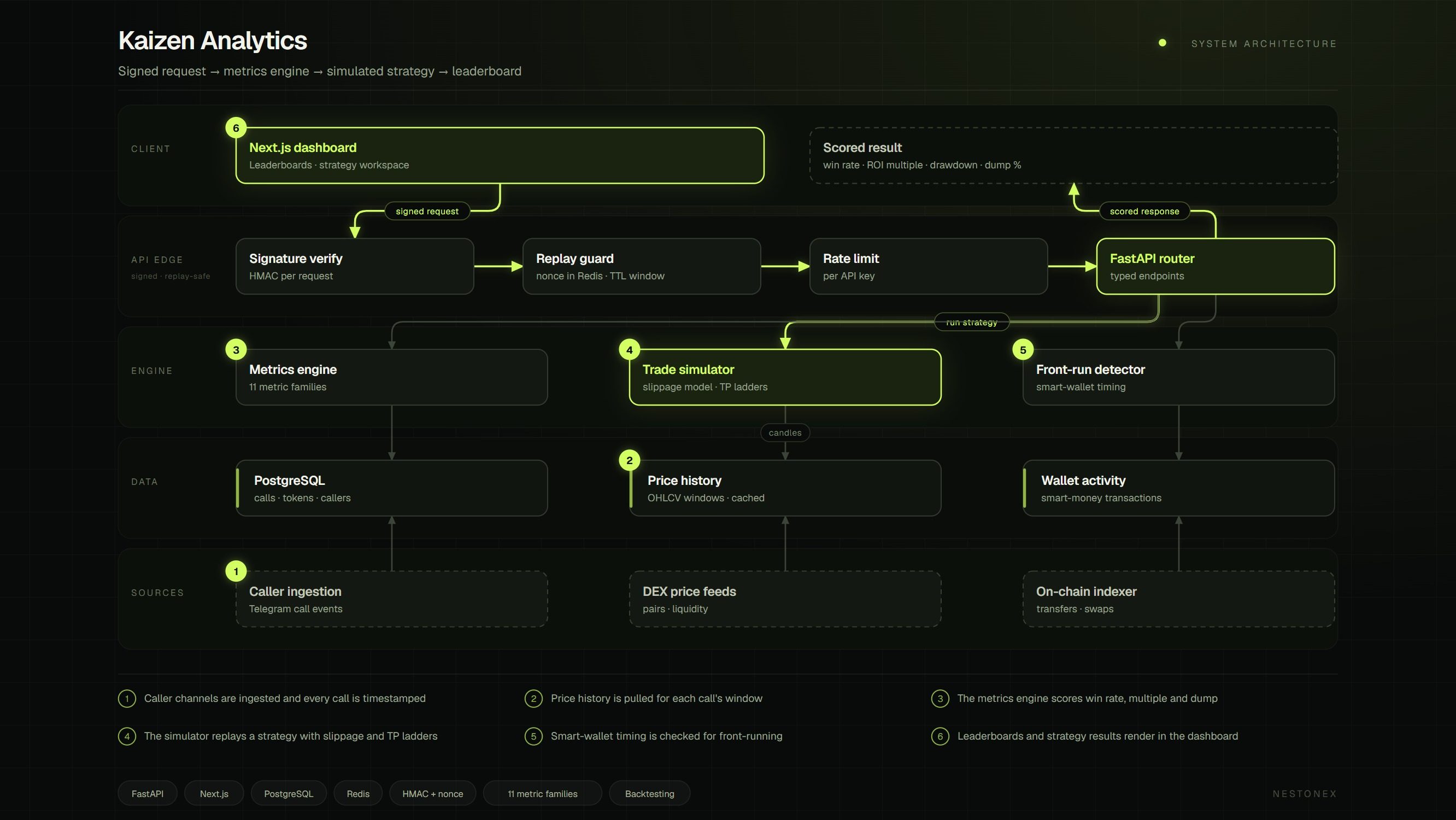
Score them against what the chain actually did. Kaizen Analytics timestamps every call, pulls the price history for that window, and computes eleven families of metrics including win rate, return multiple and dump behaviour. A simulator then replays a strategy with slippage and take-profit ladders applied.
System architecture · Kaizen Analytics
01 /Why are raw call screenshots worthless as evidence?
Because they are selected. A channel posting its winners is telling the truth about each individual call and lying about the distribution, and there is no way to audit that from the outside.
The only honest measure is every call, timestamped when it was made, scored against the price history that followed. That removes the ability to choose which trades count.
02 /What do eleven metric families actually measure?
Different questions that a single number hides. Win rate says how often a call went up; return multiple says by how much; dump metrics say how fast it fell afterwards, which is where most of the damage to followers actually happens.
A caller with a high win rate and brutal dump behaviour is not a good caller, they are a fast one. Splitting the measurement is what makes that visible.
03 /Why does the simulator model slippage?
Because a backtest without slippage is a fantasy, particularly on low-liquidity tokens where the act of buying moves the price against you.
The simulator models slippage and take-profit ladders, so a strategy is evaluated on something closer to what a real position would have returned rather than an idealised fill at the posted price.
04 /What is smart-wallet front-run detection for?
Timing. If the same wallets consistently buy shortly before a call is published, the call is not a signal, it is an exit.
Checking wallet activity against publication time turns a suspicion into something measurable.
05 /Why sign every API request and guard against replays?
Because the output of this system is reputational. Leaderboards that rank people by performance are worth attacking, and an unauthenticated or replayable endpoint is an invitation.
Every request carries an HMAC signature and a nonce with a time window, so a captured request cannot be resent later. The engine is FastAPI, the dashboard is Next.js, and the signing applies across the whole boundary.
06 /What we delivered
Metrics engine across 11 metric families
Trade-simulation and backtesting engine
Smart-wallet front-run detection
Leaderboards and a strategy workspace
07 /The outcome
A launched analytics product pairing a FastAPI engine with a Next.js dashboard, with signed, replay-protected APIs end to end.
08 /Build at a glance
Scoring
11 metric families including win rate, return multiple, dump
Data
On-chain activity and DEX price history
Simulation
Slippage modelling and take-profit ladders
Detection
Smart-wallet front-run timing checks
API security
HMAC-signed requests with nonce replay protection
Engine
FastAPI
Dashboard
Next.js leaderboards and strategy workspace
COMMON QUESTIONS
Questions people actually ask
How do you measure whether a crypto signal caller is profitable?
Score every call, not the ones the caller shows you. Timestamp each call at publication, pull the price history for the window that followed, and compute win rate, return multiple and dump behaviour separately. A single headline number hides callers whose winners are fast and whose losers are total.
Why does a backtest need to model slippage?
Because on low-liquidity tokens your own order moves the price. A backtest that fills at the posted price overstates returns, sometimes by a wide margin. Kaizen Analytics models slippage and take-profit ladders so a simulated strategy resembles what a real position would have done.
What is replay protection on an API?
A guard against a captured request being sent again later. Each request carries a one-time nonce with a short validity window, stored so a repeat is recognised and rejected. Signing alone proves who sent a request; replay protection proves they meant to send it now.
Can you detect front-running of crypto calls?
You can detect the timing pattern. If particular wallets repeatedly buy a token shortly before a call is published, that ordering is measurable from on-chain data. It does not prove intent, but it turns a suspicion into evidence that can be shown on a leaderboard.