Say it in plain language; the wallet does it safely.
Project
Web3 engineering
Year
2025
Our focus
Web3AI agentsBackend
How do you let someone run a crypto wallet in plain language without letting the model make an unsafe move?
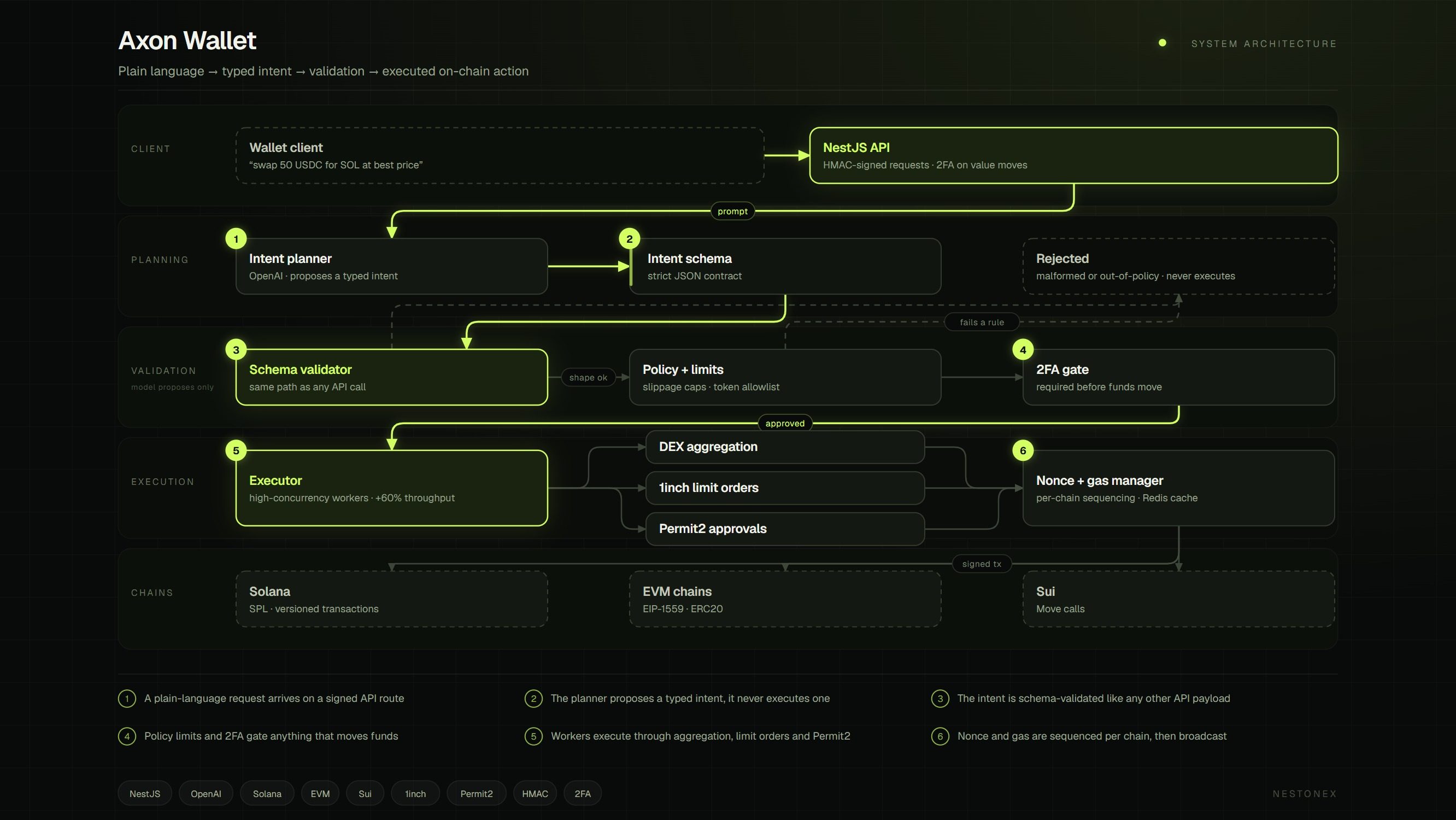
Axon Wallet separates proposing from deciding. A language model turns a plain-language request into a typed intent, and that is all it does. The intent then passes the same schema validation, policy limits and two-factor gate as any other API call before a transaction reaches Solana, EVM or Sui.
System architecture · Axon Wallet
01 /Why can a model not just execute the transaction?
Because model output is untrusted input. A wallet that lets a language model call a transfer directly inherits every failure mode the model has: a hallucinated address, a decimal in the wrong place, or an instruction smuggled in through text it was asked to read.
The safe framing is older than agents and comes from ordinary API design. The client proposes, the server decides. Axon Wallet applies that literally, so the planner sits on the client side of the trust boundary and everything it produces is treated as a request from a stranger.
02 /What does the intent planner actually produce?
Not a transaction. It produces a typed intent, a small JSON object describing what the user appears to want: an action, a pair, an amount, a chain. That object is validated against a strict schema before anything else looks at it.
If it is malformed, it is rejected. If it describes something outside policy, it is rejected. A rejected intent never reaches an executor, so the worst case for a bad generation is a failed request rather than a lost balance.
03 /How are limits and approvals enforced?
Validated intents still have to clear policy: slippage caps, a token allowlist, and per-action limits. Anything that moves value then meets a two-factor gate before signing, so a compromised session cannot quietly drain an account.
Requests are HMAC-signed end to end, which means the model is not the only thing being checked. The call itself has to prove it came from where it claims to.
04 /How does one backend serve Solana, EVM and Sui?
Each chain sits behind its own adapter, and a shared nonce and gas manager sequences transactions per chain so two concurrent actions on the same account cannot collide. The intent format stays identical across all three; only the adapter changes.
Swaps route through DEX aggregation to find a price, with 1inch limit orders for maker flow and Permit2 for gasless approvals, so a user is not signing a fresh allowance for every token they touch.
05 /What made it fast enough to run in production?
Two things, mostly. Moving execution onto high-concurrency workers raised transaction throughput by around 60 percent, and caching the read paths that were being hit repeatedly cut API latency by roughly 45 percent.
Neither is exotic, and that is rather the point: the safety layers above are cheap. Validation and policy checks cost microseconds, while the network calls they guard cost hundreds of milliseconds. Being careful here is close to free.
06 /What we delivered
Natural-language intent planner
Typed, validated on-chain actions
DEX aggregation and 1inch limit orders
Permit2, HMAC-signed APIs and 2FA
07 /The outcome
An agentic wallet backend where high-concurrency workers raised transaction throughput 60% and caching cut API latency 45%.
08 /Build at a glance
Chains
Solana, EVM, Sui
Model role
Proposes typed intents only, never executes
Validation
JSON schema, the same path as any API request
Policy
Slippage caps, token allowlist, per-action limits
Authentication
HMAC-signed requests, 2FA before value moves
Swaps
DEX aggregation with 1inch limit orders
Approvals
Permit2 gasless allowances
Throughput
Around 60% higher via high-concurrency workers
Latency
Around 45% lower via caching
COMMON QUESTIONS
Questions people actually ask
Can an AI agent control a crypto wallet safely?
Only if it is not the thing making the decision. A safe design lets the model propose a structured action and puts schema validation, policy limits and a two-factor gate between that proposal and any signing. The model's output is treated as untrusted input, exactly like a request arriving from a browser.
What is an intent-based crypto wallet?
One where the user describes an outcome and the system works out the transaction, instead of the user assembling the transaction themselves. In Axon Wallet the intent is an explicit typed object validated against a schema, which is what makes it safe to generate from natural language.
How do you stop prompt injection from moving funds?
By making sure the model cannot move funds at all. An injection can only ever produce an intent, and that intent still has to survive schema validation, a token allowlist, slippage caps and a two-factor prompt before anything is signed. A successful injection produces a rejected request.
Does the AI hold the wallet's private keys?
No. The planner has no access to signing. Keys sit behind the validation and approval layers, and the only thing the model contributes is a proposal those layers are free to reject.